

Hanuman Chalisa Lyrics in English
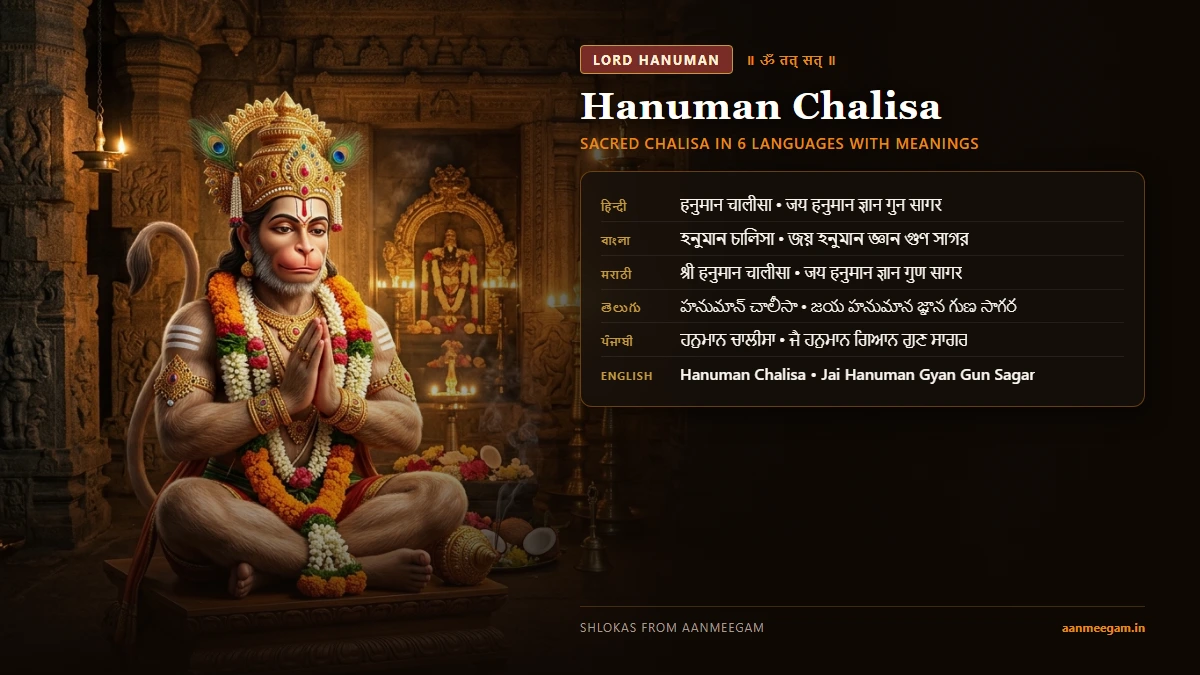
The Shri Hanuman Chalisa is a celebrated, spiritually potent devotional hymn composed in the 16th century by the saint-poet Goswami Tulsidas. Comprising two opening couplets (Dohas), forty quatrains (Chaupais), and a concluding benediction, it honors Lord Hanuman as the supreme embodiment of devotion (Bhakti), wisdom, unassailable valor, and selfless service to Lord Rama.
Hanuman Chalisa Full Lyrics
Detailed Meaning and Translation of Hanuman Chalisa
The Shri Hanuman Chalisa is a structured devotional journey of 43 verses (2 opening couplets, 40 quatrains, and 1 concluding couplet). Here is the comprehensive section-by-section devotional meaning:
• Meaning of Opening Dohas: The prayer begins with humble surrender. The devotee uses the dust of the Guru's lotus feet to cleanse the mirror of the mind, preparing the heart to narrate the pure glory of Sri Raghuvara (Lord Rama), which bestows the four classical aims of human life: Dharma (righteousness), Artha (noble prosperity), Kama (pure aspiration), and Moksha (spiritual liberation). Acknowledging personal limitation in intellect and strength, the seeker invokes Pavana-Kumara (Hanuman) to grant bodily vigor, clarity of mind, and true wisdom, while dissolving afflictions and inner impurities.
• Chaupais 1 to 10: Divine Form, Infinite Wisdom and Rama Bhakti: Verses 1 to 10 extol the divine attributes of Hanuman. He is hailed as the boundless ocean of wisdom and virtues, whose renown illuminates all three worlds. As the golden-complexioned son of Anjana and Vayu, his appearance is resplendent with earrings and curly hair, wielding a lightning-like mace and sacred flag, wearing the sacred munja thread across his shoulder. He is the incarnation of Lord Shiva (Shankara Suvana) and son of Kesari, praised throughout creation. Being the foremost among the wise, he remains perpetually eager to fulfill Sri Rama's mission, revelling in the divine nectar of hearing the Lord's praises and enshrining Rama, Lakshmana, and Mother Sita eternally in his heart.
• Chaupais 11 to 20: Heroic Feats in the Ramayana: Verses 11 to 20 recount Hanuman's pivotal acts of valor. He assumed a subtle form to speak reassuringly to Mother Sita in the Ashoka grove, an immense terrifying form to incinerate Ravana's Lanka, and a colossal form to vanquish demonic armies. When Lakshmana lay wounded by the Shakti weapon, Hanuman carried the entire Dronagiri mountain bearing the Sanjeevani herb to restore his life, earning Rama's heartfelt embrace and the profound declaration: "You are as dear to me as my brother Bharata." The verses celebrate how even thousand-headed Sheshanaga, Sanaka and the sages, Brahma, Narada, Saraswati, and the guardians of directions cannot fully capture his boundless glory. Through Hanuman's counsel, Sugriva was united with Rama and regained his throne, and Vibhishana was guided to righteousness, becoming the sovereign of Lanka. He who leapt effortlessly across millions of leagues to seize the radiant sun as a divine fruit crossed the vast ocean with Rama's signet ring in his mouth, demonstrating that all formidable challenges on earth become effortless through his grace.
• Chaupais 21 to 30: Sankat Mochan: Divine Protection and Healing: Verses 21 to 30 detail Hanuman's power as the protector against fear, malevolent forces, and physical afflictions. Serving as the vigilant sentry at Rama's sacred court, none may enter without his blessing. Taking shelter under his lotus feet dispels all dread. His mighty roar causes all three realms to tremble. Ghosts, spirits, and negative vibrations cannot approach one who utters the name of Mahavira. Continuous chanting of his holy name destroys chronic diseases and eradicates deep suffering. For those who contemplate him with dedicated thought, action, and speech, Hanuman dissolves every crisis. He who manages all affairs for Sri Rama, the supreme ascetic King, fulfills every noble aspiration of the devotee, granting inexhaustible spiritual fruit. His radiant glory shines across all four ages (Yugas), illuminating the cosmos as the protector of saints, the vanquisher of darkness, and the beloved servant of Rama.
• Chaupais 31 to 40: Ashta Siddhi, Nav Nidhi and Eternal Liberation: Verses 31 to 40 reveal the supreme spiritual boons held by Hanuman. Mother Janaki granted him the boon of being the eternal dispenser of the Eight Supernatural Perfections (Ashta Siddhis) and Nine Sacred Treasures (Nav Nidhis). In his care resides the restorative medicine of Rama's divine name (Rama Rasayana). Through devotion to Hanuman, the seeker attains Sri Rama and transcends the grief of countless lifetimes. At the end of earthly existence, the devotee reaches the supreme realm of the Lord, forever recognized as a devotee of God. While other deities demand complex rites, single-minded devotion to Hanuman confers complete peace and fulfills all desires. Whoever chants this hymn one hundred times is released from all bondage and attains supreme bliss. Saint Tulsidas concludes with the devotional plea: recognizing himself as Rama's servant, he beseeches Hanuman to make his permanent dwelling within the devotee's heart.
• Meaning of Concluding Doha: The hymn concludes with a prayer to the Son of the Wind (Pavanatanaya), the dispeller of all distress and the living embodiment of auspiciousness (Mangala Murati), beseeching him to reside forever in the heart alongside Lord Rama, Lakshmana, and Mother Sita.
Spiritual Benefits of Chanting Hanuman Chalisa
Reciting the Hanuman Chalisa daily establishes profound mental fortitude, alleviates irrational anxieties, and cultivates an unwavering core of spiritual groundedness. Practitioners traditionally recite it during dawn meditation, before facing significant hurdles, or on Tuesdays and Saturdays to invoke divine protection and focus.
Frequently Asked Questions About Hanuman Chalisa
'Chalisa' is derived from the Hindi word 'Chalis' (meaning forty), representing the forty sacred Chaupai verses that form the devotional body of the hymn.
Tulsidas indicates 'Jo sata bara patha kara koyi', traditionally interpreted as chanting it one hundred times during sacred observances, or reciting it 1, 3, 7, or 11 times as part of daily morning worship.
Verse 24 ('Bhoota pishaacha nikata nahi aavai, Mahabeera jaba nama sunavai') is widely chanted as a shield against dread, nightmares, and negative psychic impressions.
Yes. The Chalisa is celebrated for its musical, rhythmic cadence that is easily learned through phonetic Roman transliteration and audio repetition.
'Sankat' denotes suffering or crisis, and 'Mochan' signifies release. Hanuman is invoked as the divine dispeller of afflictions who liberated the Devas, Sugriva, and Vibhishana from insurmountable dilemmas.