

Kalabhairava Ashtakam Lyrics in English
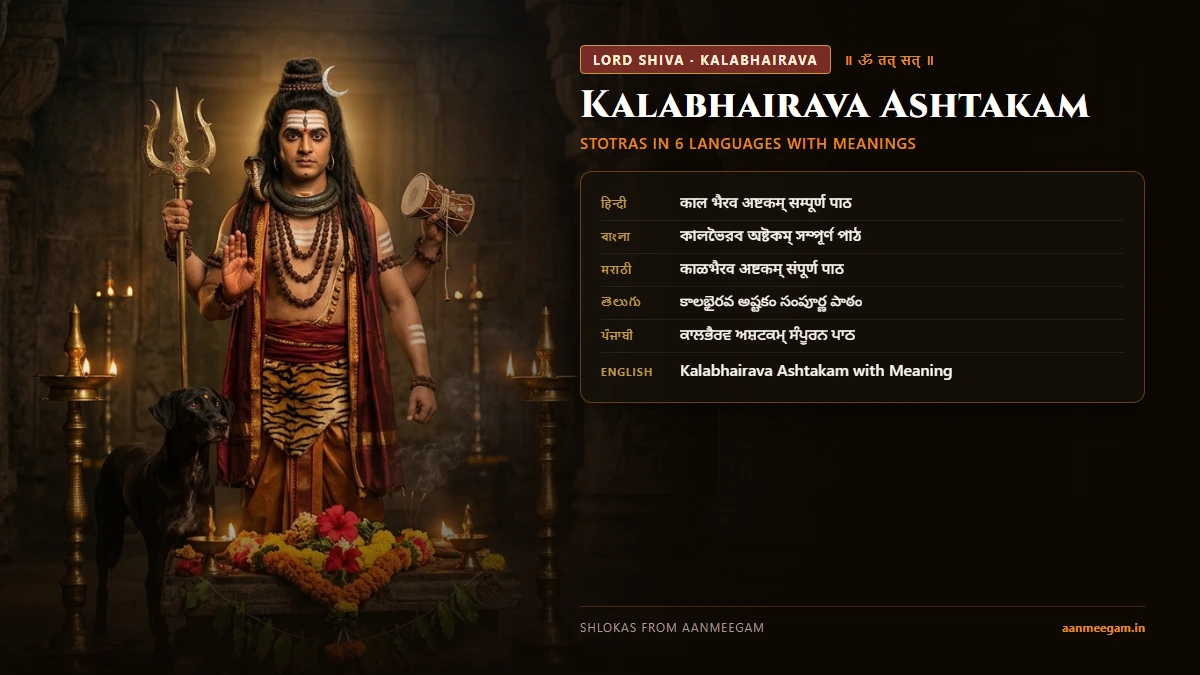
The Kalabhairava Ashtakam is a supremely powerful Sanskrit hymn composed by Adi Shankaracharya in praise of Lord Kalabhairava, the fierce, time-conquering aspect of Lord Shiva who presides over the sacred city of Kashi (Varanasi). Kalabhairava is the Kshetrapala (guardian deity) of Kashi, the vanquisher of death's pride, the dispeller of sins, and the master of time (Kala). He rides a divine hound (Shvan), carries the trident (Trishula), skull cup (Kapala), noose (Pasha), and staff (Danda) as symbols of his dominion over all existence. This ashtakam of eight powerful verses describes his radiant glory and concludes with the assurance that sincere devotees will attain his blessed feet. Kalabhairava Jayanti (Bhairavashtami), observed on the Krishnashtami of Margashirsha month, is the most auspicious occasion for its recitation.
Kalabhairava Ashtakam Full Lyrics in English
Detailed Meaning and Translation of Kalabhairava Ashtakam in English
• Verse 1, The Guardian of Kashi: I worship Lord Kalabhairava, the supreme lord of Kashi, whose pure lotus feet are served by Devaraja Indra himself; who wears the serpent king as the sacred thread (yajnopavita); who bears the crescent moon upon his crown; who is worshipped by Narada and all assemblies of yogis; and who wears the sky itself as his garment (digambara).
• Verse 2, Radiant Beyond the Sun: I worship Lord Kalabhairava, who blazes with the brilliance of a billion suns; who ferries devotees across the ocean of worldly existence; the blue-throated one (Nilakantha); the three-eyed one (Trilocana); the granter of all cherished wishes; the death of death itself (Kala-kala); the lotus-eyed one; bearer of the rosary and trident; and the imperishable (Akshara).
• Verse 3, The Cosmic Cause: I worship Lord Kalabhairava, who holds the trident (Shula), axe (Tanka), noose (Pasha), and staff (Danda) in his hands; who is the primal cause of all creation; whose body is dark like a rain cloud (Shyamakaya); the original God, imperishable, free from disease; of immense prowess; the master who delights in his wondrous Tandava dance.
• Verse 4, Bestower of Enjoyment and Liberation: I worship Lord Kalabhairava, who grants both worldly enjoyment (Bhukti) and final liberation (Mukti); whose divine form is supremely beautiful; who is tenderly devoted to his devotees (Bhaktavatsala); who is present across all the worlds; and around whose waist melodious golden anklet-bells joyfully ring.
• Verse 5, Upholder of Dharma: I worship Lord Kalabhairava, who protects the bridge of Dharma; who destroys the path of unrighteousness; who releases souls from the bondage of karma; the giver of welfare and happiness; and whose resplendent body is adorned with a golden serpentine noose (Shesha-pasha).
• Verse 6, Destroyer of Death's Pride: I worship Lord Kalabhairava, whose splendid pair of feet are glorified by the radiance of jewelled sandals; who is eternal, non-dual, the chosen deity of devotees, the pristine and stainless one (Niranjana); who crushes the pride of death; and who grants liberation through his terrible, awe-inspiring fangs.
• Verse 7, Destroyer of All Sin: I worship Lord Kalabhairava, whose roaring laughter (Attahasa) shatters the entire cosmic shell of Brahma's creation; whose mere glance destroys the entire web of sins; the fierce ruler; the bestower of the Eight Supernatural Powers (Ashta Siddhis); and who wears the garland of skulls (Kapalimalika).
• Verse 8, Lord of the Hosts: I worship Lord Kalabhairava, the supreme leader of the hosts of spirits (Bhuta-sangha); the bestower of vast fame; who purifies the accumulated merits and sins of all those who reside in Kashi; who is well-versed in the path of righteousness; the ancient, eternal lord of the universe.
• Phala-shruti, The Fruit of Recitation: Those who recite this beautiful Kalabhairava Ashtakam, which is the means to knowledge and liberation, the increaser of manifold merit, and the destroyer of grief, delusion, poverty, greed, anger, and suffering, will undoubtedly attain the blessed proximity of Lord Kalabhairava's divine feet.
Spiritual Benefits of Chanting Kalabhairava Ashtakam in English
Regular recitation of the Kalabhairava Ashtakam is traditionally observed to remove the fear of untimely death and mitigate Kala-dosha (afflictions relating to time and fate). Lord Kalabhairava, as the Kshetrapala of Kashi and master of time, bestows the qualities of discipline, courage, and divine protection upon his devotees. The stotra is especially meritorious when recited on Sundays, Tuesdays, and on Bhairavashtami (Krishnashtami of Margashirsha month). Evening and night-time recitation is considered particularly potent in the Shaiva tradition.
Frequently Asked Questions About Kalabhairava Ashtakam in English
The Kalabhairava Ashtakam was composed by Adi Shankaracharya (8th century CE) in Sanskrit. It is one of his celebrated Shaiva stotras, alongside the Shiva Panchakshara Stotra and Shivananda Lahari.
Lord Kalabhairava is the fierce, time-conquering form of Lord Shiva. He is the Kshetrapala (guardian deity) of Kashi (Varanasi) and is considered the master of Kala (time). Worshipping him is believed to remove fear, defeat enemies, dissolve karma-bonds, and grant ultimate liberation.
The stotra is traditionally recited on Sundays and Tuesdays, and most powerfully on Bhairavashtami, the Krishnashtami (eighth day of the dark fortnight) of the Margashirsha month. Evening and nighttime recitation is considered especially auspicious in the Shaiva tradition.
'Kashikapuraadhinatha' means 'the supreme lord of the city of Kashi (Varanasi)'. Lord Kalabhairava is the Kshetrapala, the presiding protector deity, of the most sacred city of Kashi, where it is said that Lord Shiva himself whispers the Taraka-mantra into the ears of the dying, granting liberation.
The Ashta Siddhis are eight supernatural powers: Anima (becoming infinitely small), Mahima (becoming infinitely large), Garima (becoming infinitely heavy), Laghima (becoming infinitely light), Prapti (reaching anywhere), Prakamya (realising all desires), Ishitva (lordship over creation), and Vashitva (control over all beings). Lord Kalabhairava is said to bestow these upon perfected devotees.